LSP-R® application guides
Build High-Performing Leadership Pipelines with SIGMA’s Free Step-by-Step LSP-R Application Guides
77% of firms report ongoing leadership gaps that threaten their ability to meet business goals.1
— Development Dimensions International’s Global Leadership Forecast.
Assessments Can Help Close Leadership Gaps
Leadership assessments provide objective information that can be used to:
- Identify high-potential talent
- Find best-fit candidates
- Highlight strengths and skill gaps
Based on this information, organizations can create personalized talent development programs that prepare top talent for critical roles.
Measure What Matters Most
The Leadership Skills Profile-Revised® (LSP-R®) is SIGMA’s flagship leadership assessment — a scientifically validated tool that measures individual potential on 50 key competencies directly linked to leader effectiveness.
Download Application Guides
To translate the LSP-R’s insights into action, we’ve created six practical, easy-to-follow application guides. Each guide provides a simple process, expert tips, and ready-to-use tools for implementing the LSP-R across the talent lifecycle. Guides include:
- Sample communications
- Meeting agendas
- Form-fillable templates
- Progress trackers
- Coaching conversation guides

Turn assessment feedback into targeted growth plans. Use the LSP-R to build strong leadership pipelines with competency-based benchmarks and personalized development plans.
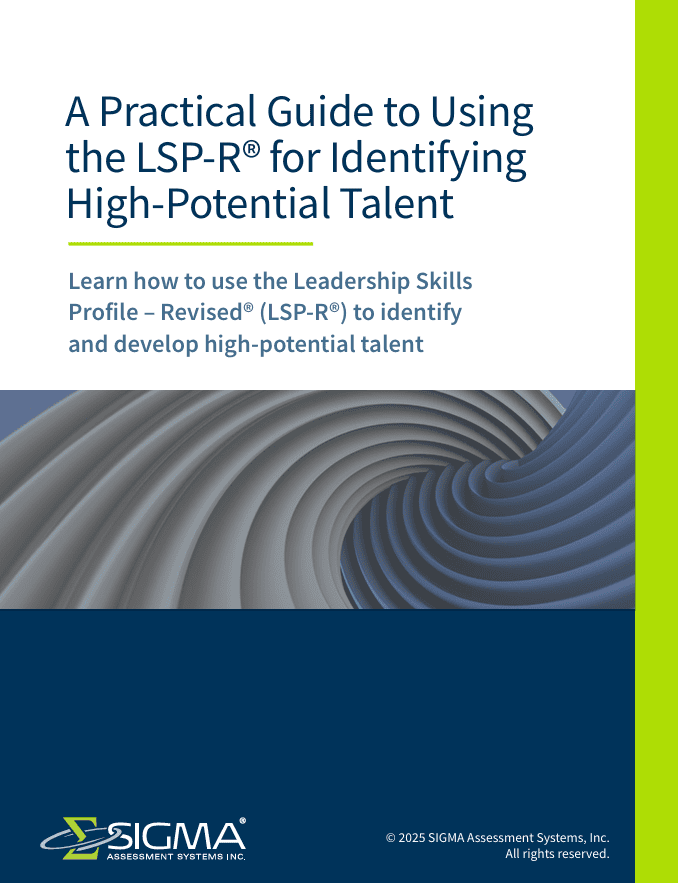
Use data to reliably identify high-potential employees and leverage LSP-R results to create development plans that attract and retain top talent.
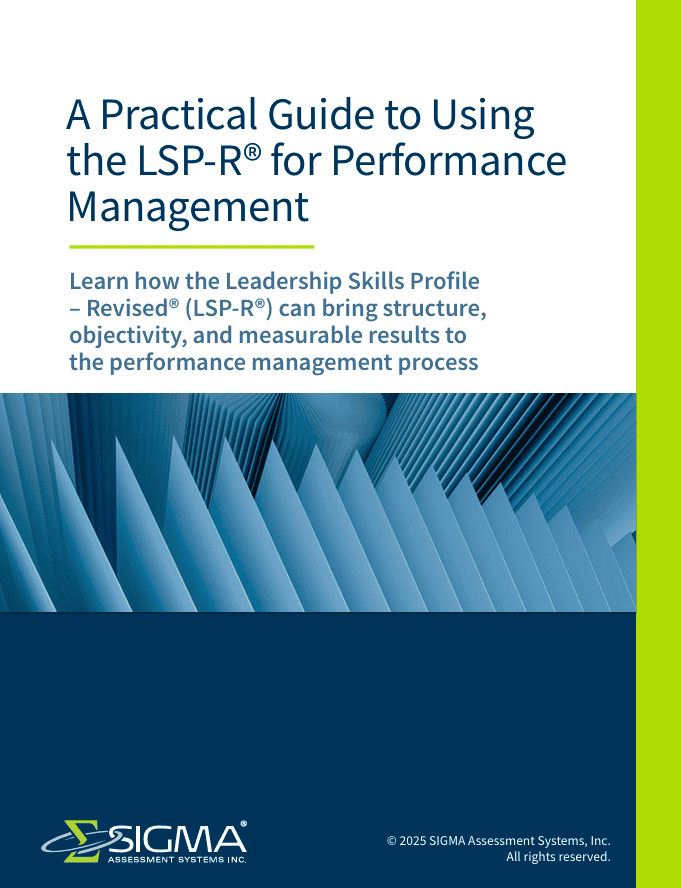
Use assessment data to design feedback and performance management processes that create a culture of growth and continuous improvement.

Learn a proven, data-driven approach to succession planning. Use the LSP-R to assess readiness, uncover gaps, and prepare leaders for key transitions.

Enhance team effectiveness by understanding leadership dynamics. Use the LSP-R to analyze individual and team strengths, identify gaps, and build complementary teams that perform better together.

Translate potential into performance. Learn how to use the LSP-R to deliver focused, actionable feedback while accelerating leadership readiness and strengthening the pipeline.

These guides are designed to turn assessment data into action at every step of the talent lifecycle
Templates and step-by-step processes were created in the context of the LSP-R, but can be applied with other assessments as well.
What is the LSP-R?
The LSP-R is a personality-based leadership competency assessment. It is scientifically validated and has been trusted by organizations worldwide to support critical talent processes such as high-potential identification, leadership development, succession planning, and more.
The ROI of Leadership Development
Studies have shown that organizations that invest in proactive leadership development are better equipped to:2
- Navigate challenges
- Adapt to change
- Drive long-term business success
In contrast, those that fail to prioritize leadership development risk lower employee engagement, reduced productivity, and widening skill gaps.3,4,5
Join more than 8,500 leading organizations across North America that trust SIGMA with their talent journey

















Creative Organizational Design (COD) has partnered with SIGMA Assessments for nearly two decades and I can report that they deliver simply excellent tools… COD has worked with many such vendors during our nearly 50 years of existence, and SIGMA stands apart … (SIGMA) is one of our “go-tos” when recommending solutions to our clients … Both we and our clients are consistently thrilled and amazed by the quality and accuracy of the results… SIGMA is a joy to work with and I can’t say enough about how highly we regard what they produce, how they market their products and services, and how they handle delivery, pricing, and customer service.
J. David Towler, MA
President, Creative Organizational Design
Why use these guides?

Evidence-Based
Built on decades of leadership research and SIGMA’s proven Leadership Competency Model.
Practical and Actionable
Clear steps, checklists, and form-fillable tools — no theory, just application.
Flexible
Suitable for organizations of any size or industry.
Free and Accessible
Submit your email address and the guide will be delivered directly to your inbox — no questions asked.
LSP-R® Free Trial
Take the LSP-R free trial to experience a data-driven, personality-based leadership assessment firsthand. See how you score on 50 key leadership competencies and receive custom feedback with templates to support development planning.
➤ Take the Free Trial
Further Applications
Leadership assessments like the LSP-R can also be used to:
Deploy leadership assessments to select and develop leaders who exemplify critical competencies valued by the organization.
Organizational culture only evolves when it’s reinforced by leadership behavior. Leadership assessments measure alignment between individual leadership styles and desired cultural values. This is critical during transformations like digital adoption, corporate restructuring, or leadership transitions. The right assessments can identify cultural champions as well as those who may resist change, helping human resources (HR) build targeted development or change management strategies.
Apply assessment insights to create effective, scalable onboarding and integration programs.
New leaders have a short window to make an impact. Leadership assessments accelerate this process by providing immediate insight into employee strengths, learning preferences, and communication styles. This insight enables tailored onboarding and faster ramp-up times.
Adopt competency-based assessments to establish a shared leadership framework to support organizations through merger- and acquisition-related change.
Leadership alignment is critical in mergers and acquisitions.6 Assessments provide a common language for evaluating leaders across merging organizations. They help identify overlapping strengths, cultural differences, and leadership gaps that could hinder integration. This data supports leadership decisions, such as who to retain, promote, or develop, while also creating transparency and fairness in a complex process.
Rely on scientifically validated assessments to ensure equitable, inclusive decision-making that supports diversity in leadership and organizational culture.
Unconscious bias often undermines fair access to leadership development and advancement.7 Leadership assessments offer standardized and scientifically validated measures that reduce subjectivity. They help ensure everyone in the organization is evaluated fairly, based on competencies rather than perceptions. Assessments can also be used to promote inclusive leadership traits like Empathy, Openness, and Collaboration, which are increasingly valued in diverse workplaces.
Leverage assessment data to align organizational human capital with long-term business goals.
Workforce planning is more effective when it includes competency-based data. Assessments allow HR leaders to forecast gaps, build leadership pipelines, and create targeted talent development plans that align people strategies with business goals.as
Utilize leadership assessments to inform executive hiring decisions, ensuring they are data-driven, objective, and aligned with organizational goals.
Executive hiring decisions have a significant impact on organizational performance.8 Leadership assessments provide critical data for evaluating candidates beyond resumes and interviews, offering insight into leadership style, decision-making, and cultural fit. They provide predictive insights by evaluating competencies, personality, and leadership potential.9 When used early in the selection process, assessments help narrow the candidate pool. Later, they guide structured interviews and inform final hiring decisions. Integrating assessments into executive search reduces risk and increases the likelihood of long-term success.
Bolster talent development by using competency-based assessments to inform personalized development plans and build strong internal leadership pipelines.
Employees want to know where their careers are headed — and how to get there. Leadership assessments provide data that helps HR and managers recommend suitable roles based on competencies and leadership traits. This ensures internal mobility decisions are based on data, not just ambition or opportunity, helping to improve retention and employee satisfaction.s
Identify high-risk behaviors early with 360-degree feedback and selection assessments to support safer, more effective leadership decisions.
Leadership missteps can be costly. Assessments identify derailers — traits such as impulsivity, arrogance, or resistance to feedback — that may lead to performance issues or cultural damage. These risks often surface when evaluating candidates for promotion, launching leadership development programs, or conducting 360-degree reviews. Proactive identification allows HR to intervene early, offering coaching or role realignment before concerns escalate.
Make informed talent decisions with assessments benchmarked to industry and organizational standards.
Leadership assessments don’t just evaluate individuals; they generate data that can be used to compare leaders across teams, departments, or even industries. This process, known as talent benchmarking, involves comparing assessment scores to internal or external standards to understand how a leader performs relative to their peers.10 Talent analytics takes it a step further by identifying patterns across the organization — highlighting teams with strong leadership potential, areas needing targeted development, and the progress of succession pipelines. Together, benchmarking and talent analytics turn assessment data into actionable insight, supporting strategic decisions about development, promotion, and workforce planning.
Support fast-paced growth by applying leadership assessments to build resilient teams, identify key contributors, and develop emerging leaders.
In early-stage ventures, hiring and leadership decisions carry outsized impact. Leadership assessments offer data-driven insights into candidate potential, team dynamics, and cultural fit. By identifying leadership strengths and gaps early on, assessments guide targeted development and reduce costly talent missteps. They also foster self-awareness, which is critical during startup and early-stage growth when roles are constantly evolving, and expectations shift quickly.
Ready to Get Started?
Leadership assessments are not just HR tools, they are strategic assets that support individual growth, team performance, enterprise transformation, and business success. If you would like to use the LSP-R to strengthen your organization’s leadership pipeline, complete the form below to start the conversation and a member of our team will contact you shortly.
Start the Conversation
1 DDI (2023). Global Leadership Forecast 2023. http://www.ddiworld.com/global-leadership-forecast-2023
2 The ROI of leadership development. (2023). New Level Work.
3 Mazzetti G, Schaufeli WB (2022) The impact of engaging leadership on employee engagement and team effectiveness: A longitudinal, multi-level study on the mediating role of personal- and team resources. PLoS ONE 17(6).
4 GOV.UK. (2025). A rapid review of reviews on the nature of the relationship between learning and development and employee engagement, wellbeing, attraction and retention. https://www.gov.uk/government/publications/learning-and-developmentemployee-engagement-and-wellbeing/a-rapid-review-of-reviews-on-the-nature-of-therelationship-between-learning-and-development-and-employee-engagement-wellbeingattraction-and-retent.
5 OECD (2024), Understanding skill gaps in firms: Results of the PIAAC employer module. OECD Skills Studies, OECD Publishing, Paris.
6 Bradt, G. B., & Pritchett, J. (2022). The merger & acquisition leader’s playbook: a practical guide to integrating organizations, executing strategy, and driving new growth after M&A or private equity deals. John Wiley & Sons, Incorporated.
7 Andrade, M. S. (2024). Addressing unconscious gender bias: strategies for leadership development. Development and Learning in Organizations, 38(1), 31–33.
8 Hurduzeu, R.-E. (2015). The impact of leadership on organizational performance. SEA — Practical Application of Science, III(7), 289–293.
9 Schmidt, F. L., & Hunter, J. E. (1998). The validity and utility of selection methods in personnel psychology: Practical and theoretical implications of 85 years of research findings. Psychological Bulletin, 124(2), 262–274.
10 Hyland, Paul & Beckett, Ronald. (2002). Learning to compete: The value of internal benchmarking. Benchmarking: An International Journal. 9. 293-304.