How to Use Leadership Assessments for Effective Performance Management
Performance management should be more than an annual review or performance rating. Done right, it can be a strategic process that drives employee development, aligns performance with business goals, and supports lasting organizational success.
The Challenges with Traditional Performance Reviews
The challenge? Many performance management systems are inconsistent, disconnected, or excessively focused on compliance.
Traditional performance reviews often compress a year’s worth of feedback into a single, stressful conversation. The result is vague guidance, uneven standards, and limited follow-through. To create meaningful improvement, performance management needs to move beyond annual rituals toward an ongoing, evidence-based process that sets role-specific expectations, builds skills, and measures outcomes over time.
The Role of Leadership Assessments in Effective Performance Management
Leadership assessments can be used to bridge the gap between subjective evaluations and objective performance metrics. By integrating a competency-based assessment like the Leadership Skills Profile – Revised® (LSP-R®) into performance management processes, organizations can move from subjective reviews to objective measures of potential and performance.
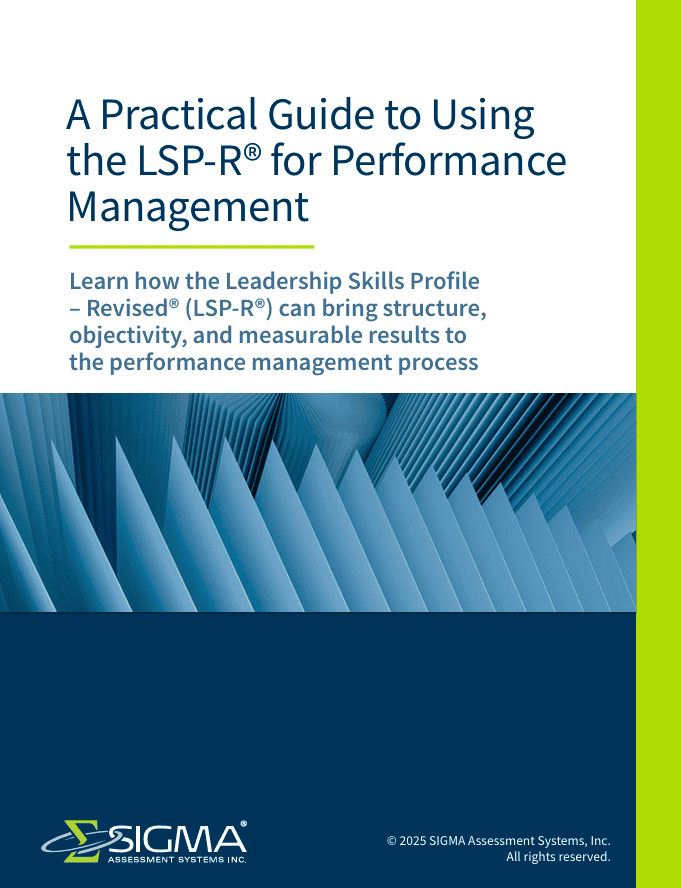
Download the Guide to Using LSP-R® for Performance Management
For tools and templates acompanying each of the steps below, download SIGMA’s Practical Guide to Using the LSP-R ® for Performance Management.
This guide includes:
- SIGMA’s Leadership Competency Framework
- The SIGMA Success Profile™ Template
- Communication Templates
- SIGMA’s Development Actions Form
- Coaching Conversation Guide
- Stop, Start, Continue Feedback Template
- Guide: Great Leaders Develop and Coach Others
- Talent Progress Scorecard
- Sample Metrics for Measuring Talent Development Progress
Why Use Leadership Assessments?
Assessments like the LSP-R offer a common language for managing employee performance. They help define what “good” looks like, pinpoint skill gaps, and focus development where it matters. When paired with a structured process, leadership assessment insights make feedback more objective, align expectations across teams, and support consistent coaching. The result is a fairer system that improves performance and accelerates company growth.
7 Steps to Leveraging Leadership Assessments for Performance Management
The following seven-step process outlines how to use assessments to strengthen performance management systems and design processes that elevate people, not paperwork.
Step 1: Define Organization-Wide Criteria
Begin by establishing a shared definition of success. Select a competency framework like SIGMA’s Leadership Competency Framework and shortlist the organization-wide competencies that matter most today, as well as a small set to work towards in the future.
Download our Competency Checklist to select which leadership competencies are critical at your organization.
Step 2: Communicate the Process
Introduce the new performance management process to people leaders first. Clarify how the assessment and success profiles work together to set expectations, identify gaps, and guide coaching. Outline timelines, responsibilities, and how results will be used. In larger organizations, consider piloting with a subset of teams before expanding.
Step 3: Define Role-Specific Requirements
Translate the organization-wide model into role-specific expectations. Instruct leaders to complete a success profile for each critical role, identifying must-have leadership competencies now and those to develop next. This creates fair, role-aligned criteria for assessing performance and setting goals.
Download our SIGMA Success Profile™ template for an easy way to get started.
Step 4: Assess Current Competencies
Invite employees in critical roles to complete a leadership assessment like the LSP-R. Use the results report to understand their strengths and development needs at a glance. Ensure a clear timeline, provide technical support, and communicate confidentiality. The aim is to inform coaching and development — not to surprise anyone at review time.
Step 5: Create Personalized Performance Goals
Use the Development Actions Form to co-create focused goals that target the most impactful competency gaps. For each goal, define success, near-term actions, and support required. Keep the list short so progress is clear and momentum builds.
Step 6: Facilitate Talent Review Discussions
Equip managers to run short, regular one-on-one check-ins. Introduce a simple structure — such as the Stop, Start, Continue method — to make feedback clear and actionable. Pair this with quarterly reviews of Development Actions Forms to reinforce accountability and celebrate wins.
Step 7: Scale and Sustain Performance Programs Across Teams
Once the process is working, scale deliberately. Use SIGMA’s Talent Progress Scorecard to track outcomes at the individual, program, and organization levels. Share results with stakeholders, refine the process, and keep leaders engaged to sustain a culture of continuous development.
LSP-R® Free Trial: Get Your Leadership Focus Report
Is your organization new to the LSP-R? Begin with a free trial to see how a data-driven, personality-based assessment elevates performance management. In only 25 minutes, you’ll receive a Focus Report with your scores on 50 key leadership competencies, as well as personalized feedback and planning templates that you can apply immediately.
➤ Take the Free Trial
Performance Reviews Shouldn’t be an Afterthought
Effective performance management is an ongoing practice, not an annual task. Grounding the process in clear role requirements, objective assessment, and regular coaching creates fairness, transparency, and measurable progress. With the LSP-R and SIGMA’s structured approach, organizations can deliver performance reviews that actually develop people — and move the organization forward.
Want to Put the 7-Step LSP-R® Performance Management Process Into Action?
Download SIGMA’s Practical Guide to Using the LSP-R® for Performance Management
Build clarity, consistency, and momentum with SIGMA’s flagship leadership assessment — the LSP-R®. This practical guide outlines a step-by-step process for using the LSP-R to build a structured, development-focused performance review process, complete with ready-to-use templates, tools, and communication resources.
This guide includes:
- SIGMA’s Leadership Competency Framework
- The SIGMA Success Profile™ Template
- Communication Templates
- SIGMA’s Development Actions Form
- Coaching Conversation Guide
- Stop, Start, Continue Feedback Template
- Guide: Great Leaders Develop and Coach Others
- Talent Progress Scorecard
- Sample Metrics for Measuring Talent Development Progress
Looking for More?
Complete the form below and a member of our team will be in touch to learn about your organization’s needs, discuss your goals, and outline next steps for leveraging SIGMA’s tools and services to build a strong leadership pipeline at your organization.