How to Use Leadership Assessments to Identify High-Potential Employees
Why Relying on Intuition Isn’t Enough for Identifying High-Potentials
Many organizations still rely on manager intuition or tenure to identify high-potential talent. The result? Promising candidates are overlooked due to bias, decisions are made inconsistently, and there are critical gaps in the leadership bench. The reason? High performers don’t always make great leaders, and future leaders don’t always stand out right away.
Leading organizations take a different approach. They use evidence-based leadership assessments like the Leadership Skills Profile – Revised® (LSP-R®) to identify high-potential employees early, often before they’re identified using traditional methods.
Download the Guide
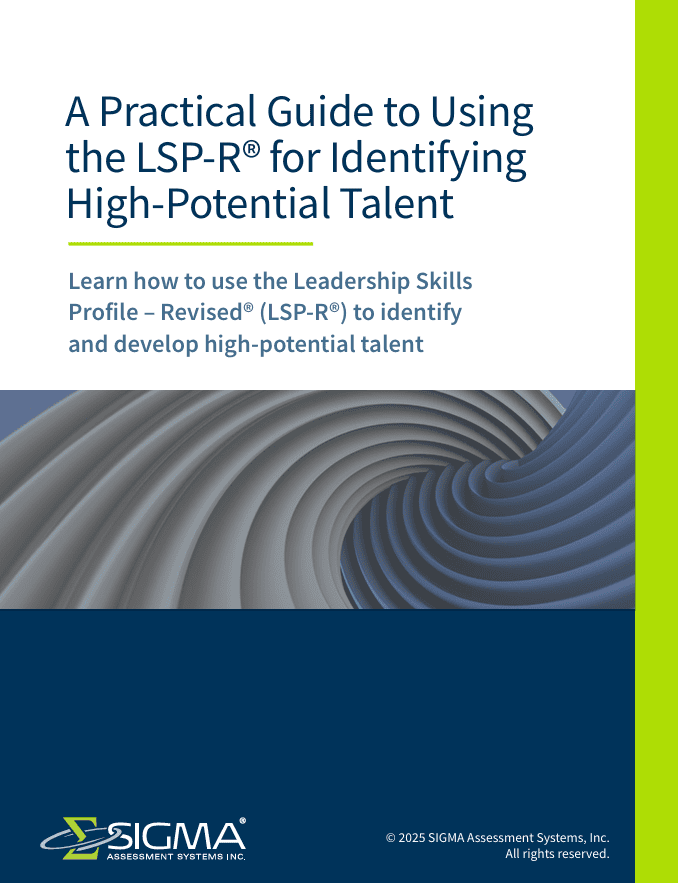
For tools and templates acompanying each of the steps below, download SIGMA’s Practical Guide to Using the LSP-R ® for Identifying High-Potential Talent.
Includes:
- High-Potential Criteria Checklist
- LSP-R Communication Template
- High-Potential Nomination Checklist
- LSP-R Administration Guide
- High-Potential Profile Template
- Assessment Results Summary Grid
- Talent Review Meeting Guide
- Development Actions Form
- Development Activities Menu
- High-Potential Progress Dashboard
- LSP-R Reassessment Tracker
8 Steps for Leveraging Leadership Assessments to Find High-Potential Talent
The following eight-step process outlines how to use assessments to strengthen leadership pipelines and to turn strategy into execution.
Step 1: Define What High Potential Means
Every organization has a unique leadership culture. Start by establishing high-potential criteria that reflects the values, competencies, and capabilities required for future leadership roles in your organization.
How Leadership Assessments Help:
- Measure leadership potential using validated leadership competencies.
- Highlight the gap between current performance and future capability.
Practical Tip:
- Define high-potential selection criteria using leadership competencies and knowledge, skills, and abilities (KSAs).
- Prioritize critical roles and build targeted talent pools early.
Step 2: Communicate the Process Internally
Transparency and clarity are key to program success.
How Leadership Assessments Help:
- Create a shared language for discussing readiness and suitability with leaders and human resources (HR).
Practical Tip:
- Educate managers on the definition of “high potential” and the role of assessments.
- Clearly communicate timelines, expectations, and privacy considerations for nominated employees to build trust and engagement.
Step 3: Nominate an Initial Talent Pool
Use the defined talent criteria to identify a preliminary group of high-potential candidates through collaboration between HR and leadership.
How Leadership Assessments Help:
- Provide a common language and framework to guide nominations and reduce unconscious bias.
Practical Tip:
- Engage a diverse group of stakeholders in the nomination process to promote fairness and objectivity. In addition to HR, involve executive leaders, managers, department heads, and team leads.
- When uncertain, err on the side of inclusion. Nomination is not selection; it simply signals leadership potential. Final decisions can be made later, once more information is gathered in subsequent steps.
Step 4: Evaluate Leadership Potential Objectively
Assessment data replaces guesswork with science. Rather than relying on instinct, organizations can evaluate leadership potential at scale with scientific accuracy.
How Leadership Assessments Help:
- Provide structured insight into individual capabilities and future readiness.
- Reveal hidden leadership potential, challenge assumptions, and reduce manager bias.
Practical Tip:
- Use a validated leadership assessment like the Leadership Skills Profile – Revised® (LSP-R®) to inform nominations and ensure decisions are competency-based and data-driven.
LSP-R® Free Trial
Are you new to using the LSP-R? Take the free trial and experience the assessment for yourself to see whether it’s a good fit for your team. In only 25 minutes, you will receive a comprehensive Focus Report with your scores, personalized feedback, and templates to support your development planning.
➤ Take the Free Trial
Step 5: Analyze Leadership Assessment Data
Assessment results must be translated into insight to inform decisions.
How Leadership Assessments Help:
- Offer comprehensive profiles to evaluate candidates against high-potential criteria.
- Highlight strengths, competency gaps, and readiness levels using the LSP-R and other tools.
Process Tip:
- Summarize results in standardized talent profiles to visualize strengths and development needs.
Step 6: Facilitate Talent Review Discussions
Structured meetings align stakeholders with objective data and calibrated decisions.
How Leadership Assessments Help:
- Provide objective evidence to support or challenge subjective impressions.
- Reveal hidden talent and reduce bias during group decision-making.
Process Tip:
- Finalize high-potential selections through discussion; be sure to use a standardized selection process and templates, and document the rationale for decisions made.
- Outline next steps (see Step 6).
- Consider providing your leaders with coaching training to ensure that they are equipped to guide high-potential candidates through the leadership development process.
Step 7: Develop High Potentials with Personalized Plans
Identifying high-potential employees is only the beginning. Development drives leadership readiness.
How Leadership Assessments Help:
- Provide personalized development insights tailored to future leadership roles.
- Highlight competency gaps and strengths for targeted growth.
Process tip:
Build Individual Development Plans (IDPs) that include:
- Targeted leadership training
- Coaching and mentoring
- Cross-functional projects
- Stretch assignments
Step 8: Monitor Progress and Refresh the Pool
Leadership potential evolves over time. Effective high-potential programs adapt by reassessing and refining IDPs and program-wide processes.
How Leadership Assessments Help:
- Track progress with a 360-degree feedback assessment, such as SIGMARadius 360-Degree Feedback every 12–18 months.
- Visualize bench strength and leadership pipeline readiness across teams.
Process tip:
- Conduct regular reviews of development progress and reassess high-potential employees.
- Measure success through promotions, retention rates, and readiness scores.
Final Thoughts: Great Leaders Start as High-Potentials
Leadership potential doesn’t always shout, it often whispers. The key is to listen with the right tools. Leadership assessments provide the insight and confidence required to make high-stakes talent decisions with clarity and consistency.
Overlooking emerging leaders is a risk that organizations can’t afford.
Want to Put This 8-Step Process Into Action?
Download SIGMA’s Practical Guide to Using the LSP-R® for High-Potential Identification
Discover how to define high potential employees, apply leadership assessments effectively, and strengthen your talent pipeline with SIGMA’s flagship leadership assessment — the LSP-R®. This practical guide offers step-by-step strategies with templates and tools to help you put your high-potential identification process into action.
This guide includes:
- High-Potential Criteria Checklist
- LSP-R Communication Template
- High-Potential Nomination Checklist
- LSP-R Administration Guide
- High-Potential Profile Template
- Assessment Results Summary Grid
- Talent Review Meeting Guide
- Development Actions Form
- Development Activities Menu
- High-Potential Progress Dashboard
- LSP-R Reassessment Tracker
Looking for More?
Complete the form below and a member of our team will be in touch to learn about your organization’s needs, discuss your goals, and outline next steps for leveraging SIGMA’s tools and services to build a strong leadership pipeline at your organization.
